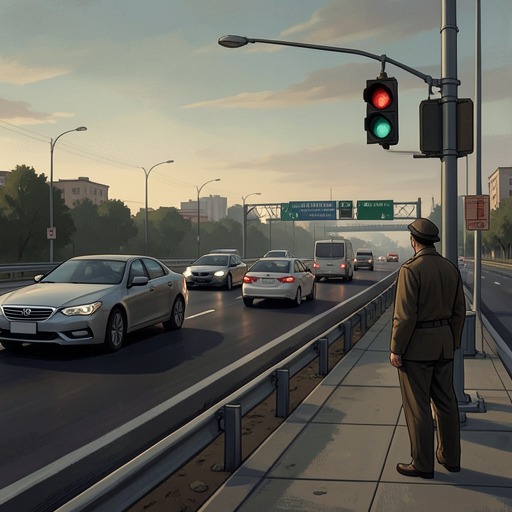
Traffic flow theory
The Wisdom of CrowdsTraffic flow theory studies how vehicles moving along roads interact, and how those local interactions can produce large-scale patterns, including queues, jams, and waves of motion. The book invokes research on highway traffic to show that collective behavior need not be directed by a central decision-maker: traffic can organize into recognizable states through the movements of individual drivers. Its significance lies both in explaining congestion and in providing a concrete example of how a system’s overall behavior can emerge from many connected local decisions.
Traffic as a Collective System
The account situates traffic flow theory within the broader scientific effort to understand why jams form and how they propagate. A traffic jam is not treated simply as a pileup of individually poor choices. Research instead examines relationships among average speed, traffic flow, occupancy, and density, and asks how those variables change as vehicles accumulate on a road. Observations of highways with long queues and studies of freeway bottlenecks give this work an empirical basis: the patterns of congestion can be investigated through what traffic actually does, rather than attributed only to drivers’ intentions.
The book connects this research to a general account of collective intelligence and coordination. Decentralized systems can draw on the local knowledge of their participants, but information held in separate places is useful to the whole only when the system can somehow integrate it. Traffic offers a vivid case of the same tension. Each vehicle is part of a larger flow, and the resulting pattern depends on how movements and conditions relate across the road. The system’s behavior is collective even when no single driver controls it.
Measuring Flow and Congestion
The cited work makes distinctions among quantities that can otherwise seem interchangeable. Average speed, flow, and occupancy are related measures, while density and occupancy have an analogous relationship; examining these connections helps researchers describe how traffic changes as a road becomes more crowded. Studies of long queues and observations at freeway bottlenecks focus attention on the conditions under which an initially moving stream becomes unstable or congested.
This emphasis on observation matters to the book’s wider argument. A group or system can contain useful information without any individual possessing the whole picture. Traffic research makes the aggregate pattern legible by relating measurements taken within the flow. Rather than treating congestion as a mystery or as a single driver’s mistake, the approach searches for regularities in the system’s behavior and for transitions between different traffic conditions.
Jams, Waves, and Coherent Motion
Research cited in the book describes traffic jams as waves and clusters, and examines coherent moving states on highways. These terms frame congestion as a dynamic pattern: a disturbance can persist or travel through traffic, while vehicles continue to enter and leave the affected region. The relevant object of explanation is therefore not only the stationary line of cars but also the changing relation between the jam and the surrounding flow.
The studies of phase transitions in highway traffic likewise point to changes in the state of the system. Traffic is not simply either moving freely or stopped; the observed relations among speed, flow, and occupancy can shift as conditions change. This perspective links the microscopic movements of vehicles to larger, organized forms, making traffic a useful example of how local interactions can generate collective patterns without a top-down plan.
Modeling and Practical Significance
The book’s references include both observational research and modeling approaches to traffic flow and traffic jams. Work on traffic modeling, coherent moving states, and economics-based optimization of unstable flows treats congestion as a problem whose structure can be analyzed, rather than as an unavoidable by-product of travel. Together, these approaches connect empirical measurements with efforts to understand how unstable flows arise and how their organization might be improved.
Traffic flow theory thus contributes to the book’s account of decentralization and coordination. Individual knowledge and action remain local, but their consequences are not: each movement becomes part of a larger pattern that can be measured, modeled, and interpreted. The highway illustrates a central challenge for complex systems—how to preserve the contribution of many separate actors while understanding the collective behavior their interactions create. In this sense, the science of traffic is not only about roads; it is a case study in the emergence and coordination of collective outcomes.